


Unsupervised Learning…. First of all, let me introduce you about the Machine learning. It is the subset of AI that focused on algorithms which understand the patterns of trained data and make accurate ideas about new data.
Table of Contents
ToggleWhat is Unsupervised learning?
Unsupervised learning is a type of machine learning that learn from unlabeled data without the need of human intervention and it discover the hidden pattern and insights. For an example, Let say an insurance company has millions of customers’ policy details and if they don’t have any information about their policy categories, Unsupervised learning can group customers with similar policies. Also, whether you realize it or not, every aspect of our daily life is impacting by AI and ML, for instance in online shopping, unsupervised learning is used to generate buyers persona profiles by clustering our purchasing behaviors. And Unsupervised learning helps organizations to recognize data insights that lead to improve efficiency, better decision making and reduce costs.
How does Unsupervised learning works?
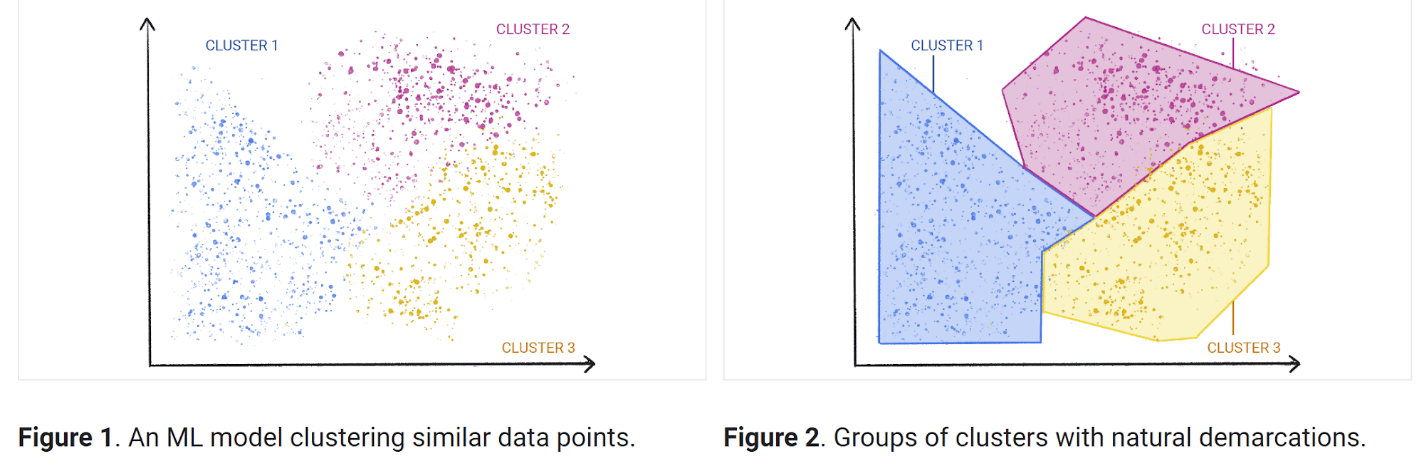
Unsupervised learning works as self learning algorithms, they lean without any prior training and they infer its own structure based on similarity and patterns. It possesses two common methods termed as clustering and association. In clustering, algorithms like K Means divide data points into groups based on similarity, It clearly visible in the figure 1. Also, figure 2 displayed the way it grouped. On the other hands, association identifies relationships between variables. For an example, people who buy bread also buy butter. Unsupervised learning involves the following steps
Input unlabeled data sets: enter the data sets into ML algorithms.
Pattern identification: identify patterns within the training data sets.
Clustering and association: categorized them into clustering and association tasks.
Evaluation: assess the quality of the discovered structures.
Also, Unsupervised learning algorithms adjust themselves to reduce the cost and optimize the similarity measures without needing the helps of human.
Why Unsupervised learning is important?
Unsupervised learning is important because in real word we can’t find labeled data, it always unstructured or unlabeled data. This allow organization and researchers to discover insights that they didn’t even know existed. For examples, healthcare people use unsupervised learning to detect disease patterns in patient data and cybersecurity team use unsupervised learning to find unusual network activities that indicating threats.
When we compare the unsupervised learning with other approaches, following are some of the important factors. When we compare the unsupervised learning with other approaches, following are some of the important factors.
Handles complex tasks: it is more useful when the initial input data is more complex. However, it is ideal for larger data sets.
Identifies underlying patterns: it can identify the common factors between complex amount of different data sets.
Data discovery: it explores the raw data to find out underlying structures.
Dimensionality Reduction: it can reduce the complexity of data by decreasing the no of features.
What does need to consider when implementing?
There are several factors that you should consider when implementing the unsupervised learning, first we need to consider the quality of the data as the algorithm’s performance depend on the clean data set, missing data can lead to misleading the clusters. Then need to consider the choice of algorithm such as K means work with spherical clusters and DBSCAN handle irregular cluster shapes. Then the number of clusters as some algorithm require predefine clusters, selecting wrong value may affect the effectiveness of the model. Finally we need to consider the interpretability since there are no label data, visual tool like PCA can help interpret results. Also, need to consider about the Scalability as large data sets may require optimization to avoid long waiting time. In the end, testing and validation of unsupervised model will ensure that it generalize well.
The unsupervised learning is an essential technique that help you to understand the structure in unlabeled data. Also, not only pros, there are challenges of unsupervised learning
Misleading data: By having wrong data sets, outliers can identify unsafe patterns
Assumption: Algorithms relay on assumption which may not match the actual structure.
Lack of Guidance: without using labels data sets, it may prevent the ability to guide algorithm toward results.
Interpretability: Results may not very clear with real world outcomes to compare them.
Also, here are few applications of unsupervised learning, it has applications across industries and key applications include
- Customer Segmentation
- Recommendation Systems
- Image and Text Clustering
- Social Network Analysis
- Anomaly Detection